SITA Medical Clinic · Lat Lum Kaeo, Pathum Thani

Daily 08:00–19:30

Freckles · FRECKLES & PIGMENTED SPOTS

Brown spots called “freckles” may not all be the same concern

Some spots are scattered individually, some become more noticeable with sun exposure, and what is called “freckles” may sometimes be confused with melasma or dark marks.

Begin by understanding what is visible on the skin, before choosing an approach to fading it.

This page provides general information for understanding. It does not offer a diagnosis or individual treatment advice.

Some spots are scattered individually, some become more noticeable with sun exposure, and what is called “freckles” may sometimes be confused with melasma or dark marks.

This page provides general information for understanding. It does not offer a diagnosis or individual treatment advice.

02 — One Word, Different Contexts ONE WORD, MORE THAN ONE CONTEXT

The word “freckles”
is often used for brown spots
of different kinds

Freckles

An everyday term for brown spots that may have different explanations.

Brown spots scattered across the face may look similar at first glance.

Their distribution, how clearly defined their edges are, when they were first noticed, sun exposure and other skin changes all help inform a more detailed assessment.

  1. 01 Distribution of the spots
  2. 02 How clearly defined the edges are
  3. 03 When they were first noticed
  4. 04 Sun exposure
  5. 05 Other skin changes present

These observations are not a way to diagnose yourself. They help you begin a discussion with a doctor using what you have actually noticed.

03 — Freckles and Sun Spots FRECKLES · SOLAR LENTIGINES

Similar-looking spots
may have different contexts

In everyday Thai, freckles and sun spots are often grouped under the same term. Medically, they may be considered separately. Distinguishing them requires examination of the skin, rather than relying on the name used.

Cheek skin in natural light
01

Freckles

FRECKLES

Small brown spots that are often individually scattered. Some people have noticed them since a young age.

Some people notice that the spots become more or less visible during periods of differing sun exposure.

02

Sun Spots

SUN-RELATED SPOTS

Some brown spots may become more noticeable in the context of sun exposure accumulated over many years.

These spots may also be called “freckles”, although their context may differ from spots noticed since a young age.

Different contexts call for different considerations during assessment.

These two examples support understanding. They are not criteria for identifying the type yourself and do not specify which care approach each requires.

04 — Freckles and Melasma FRECKLES ≠ MELASMA

Individual freckles and patches of melasma
should not automatically be grouped together

Freckles

FRECKLES · This page
Spots

Often appear as separate brown spots with fairly distinct edges.

Melasma

MELASMA · /melasma/
Patches

Often appear as broader patches that may cover an area.

However, skin findings do not always fit neatly into these categories.

  1. 01

    Appearances may overlap. Some spots can resemble patches, and some patches can resemble spots.

  2. 02

    Freckles and melasma may occur on the same face.

  3. 03

    This difference is a reason to seek assessment first, rather than a rule for identifying them at home.

Appearances may overlap, and both may occur together. This is a reason to begin with assessment.

05 — Freckles and Dark Marks FRECKLES ≠ EVERY DARK MARK

Post-inflammatory dark marks
are not always “freckles”

Dark marks left after skin inflammation, such as acne, have a different context from freckles, even when both appear brown.

What you can tell your doctor

Was there acne, a rash or irritation in that area before the mark appeared?

Did the mark appear around the time of that inflammation?

06 — Seborrheic Keratosis SEBORRHEIC KERATOSIS

“Kra nuea” shares the Thai word for freckles
but differs from flat pigmented spots

The everyday Thai term “kra nuea” usually refers to seborrheic keratosis , a common lesion of the upper layers of the skin in adults.

It may be flat or raised, smooth, rough or appear stuck onto the skin. Its colour can also vary.

Freckles / Sun spots
Colour

The main feature is a pigmented spot or mark, which does not necessarily have a raised surface.

Seborrheic Keratosis
Texture

The lesion may be raised or have a texture that differs from the surrounding skin. These features are not criteria for self-diagnosis.

01

Assessment before removal

Several skin lesions can look similar in photographs or to the eye. If a lesion is unclear, grows or changes quickly, bleeds or differs from others, it should be assessed before choosing a removal method.
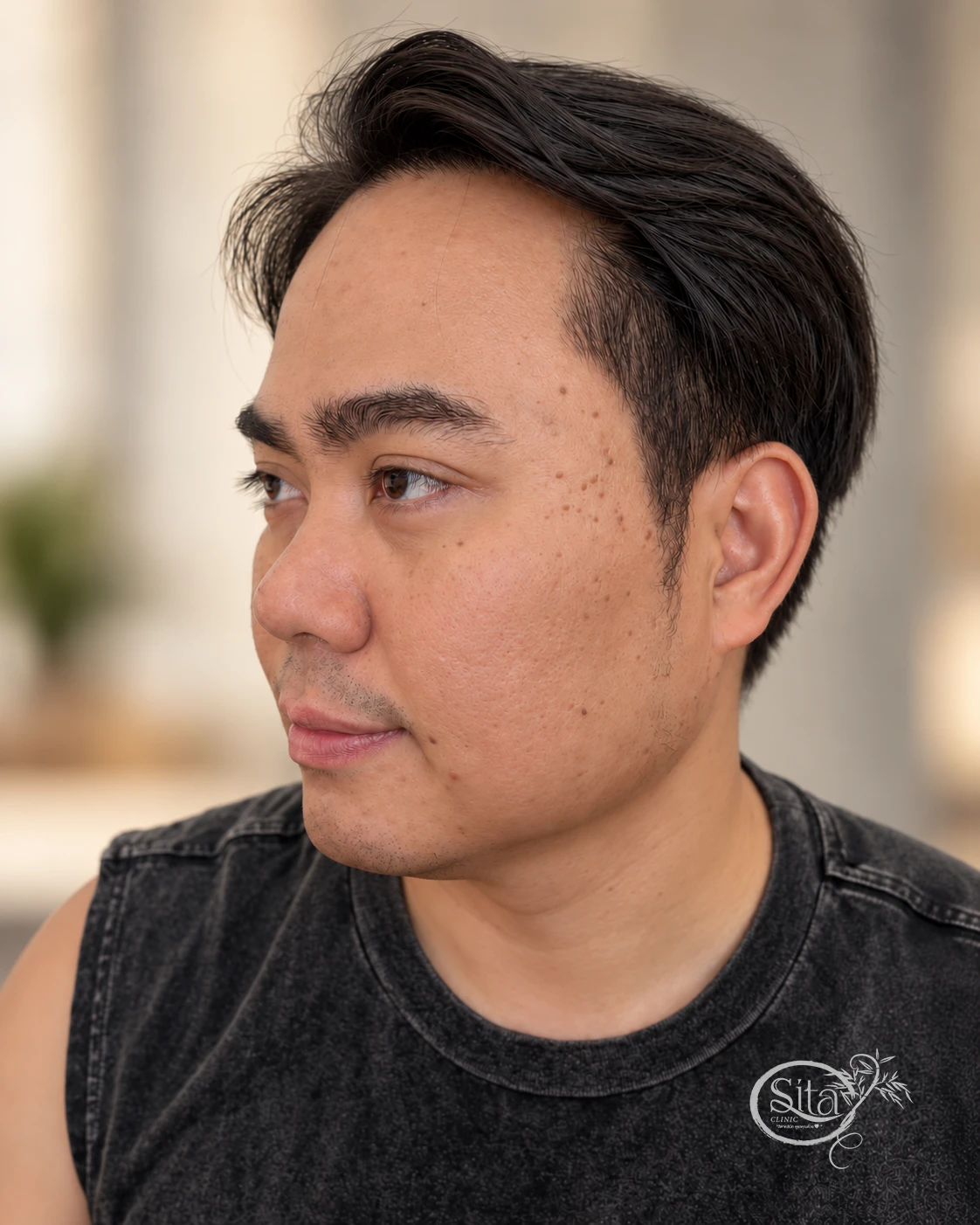
Actual skin before assessment of raised lesions and brown spots
This photograph of actual skin illustrates the context of assessment. It is not intended to identify a lesion from an image alone.
When assessment confirms that removal is appropriate

SITA uses SURTRON
for electrosurgical removal in suitable cases

SURTRON is a high-frequency electrosurgical system, distinct from a CO₂ laser. The doctor selects the settings and technique according to the lesion’s characteristics and the area being treated.

01
Not every lesion needs removal

Most seborrheic keratoses are benign and may not need treatment if they are not troublesome.

02
Electrosurgery is one option

Electrosurgery is one method used to remove seborrheic keratoses when assessment finds it appropriate.

SITA · SAME-SPOT CARE GUARANTEE

Same-Spot Care Guarantee

If a lesion treated by SITA remains or becomes visible again at the same location, you may return for reassessment and repeat electrosurgery under the clinic’s guarantee terms.

The same spot Return for reassessment or repeat treatment under the terms
A new spot Treated as a new lesion, with an additional charge

Redness, changes in pigmentation or scarring may occur after removal and vary between individuals. The doctor will assess suitability before the procedure.

07 — More Than One Concern OVERLAP

The same skin
may have several concerns
at once

Freckle-like spots, melasma-like patches, marks left after inflammation and raised or textured lesions sometimes called “kra nuea” may coexist on the same face. Each may need different consideration.

Freckle-like spots Section 03
Melasma-like patches Section 04 · /melasma/
Marks left after inflammation Section 05
Raised or textured lesions sometimes called “kra nuea” Section 06

These examples describe concerns that may coexist. They do not identify what is present on your skin.
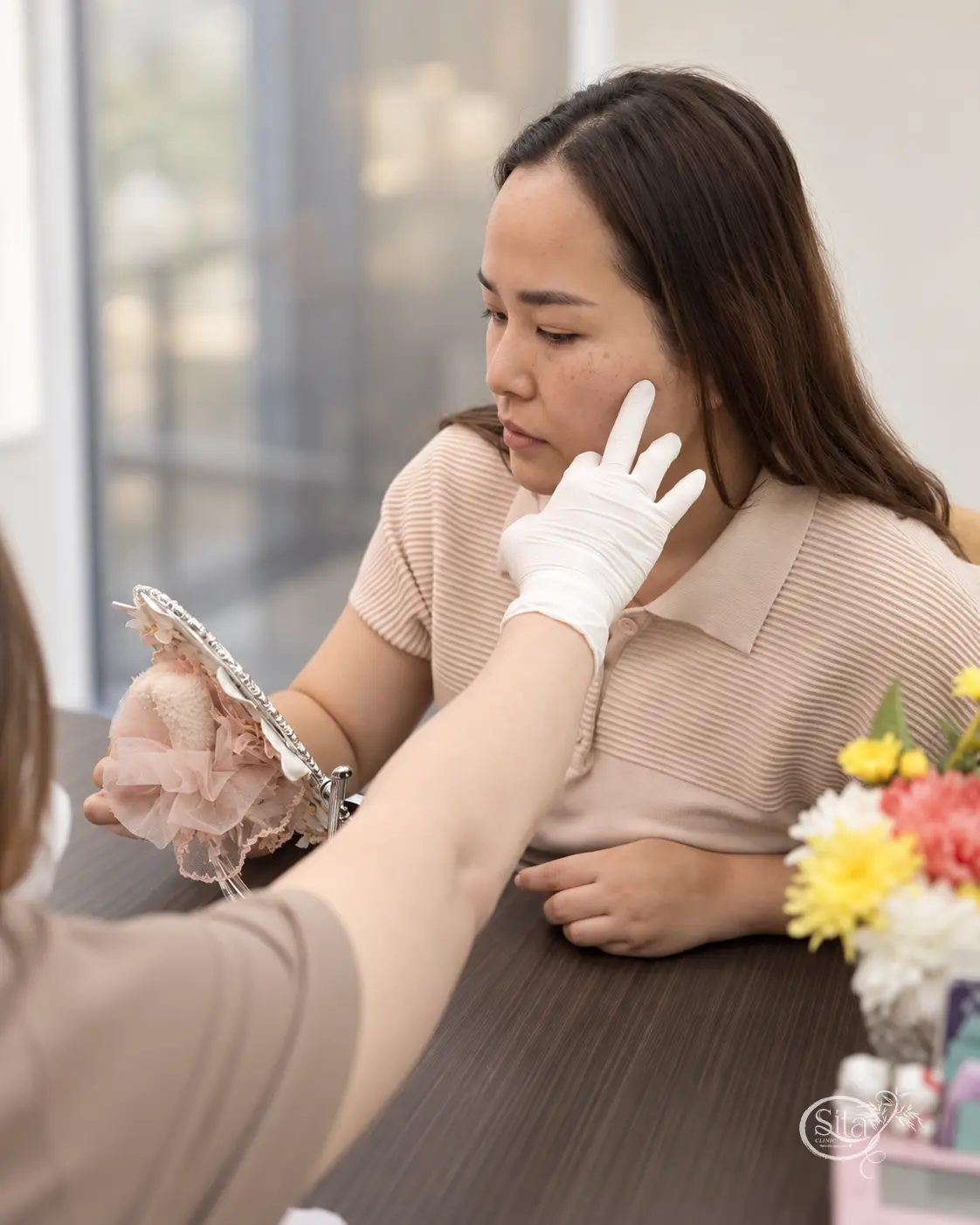
A doctor assesses the patient’s skin in natural light

Having one feature does not rule out another occurring alongside it.

A single photograph

Lighting, camera angles and image editing may make the colour, edges or texture of a lesion look different from its actual appearance.

A single search term

The Thai word “kra” can encompass several concerns. Search results may therefore discuss something different from what is present on your skin.

A photograph or search term can help begin a discussion, but is not enough to identify the concern or decide on care.

Photographs and search terms can help start a discussion, but are not enough to decide on care.

08 — Before the Plan BEFORE THE PLAN

Before considering
how to fade a mark,
first understand
what needs care

Assessment considers the context of visible spots, marks or changes, and what else may be present, before discussing an approach to care.

This list describes areas an assessment may consider. It is neither diagnostic criteria nor a self-check.

What an assessment may consider

  1. 01 The appearance of spots, marks or raised lesions
  2. 02 Their distribution on the face
  3. 03 When they were first noticed
  4. 04 Changes over time
  5. 05 Everyday sun exposure
  6. 06 Pigmentation changes in nearby areas
  7. 07 Your skin’s current condition
  8. 08 Previous care and products used

Visible skin findings are only part of an assessment. Context and history help build a fuller picture before planning care.

09 — Everyday Context DAILY CONTEXT

Sun exposure
is part of the context
but does not explain every spot

Sun exposure is often discussed in relation to freckles and may be important for some types of spots. This does not mean that every brown spot is caused by sunlight alone.

Daily skin care supports assessment; it does not replace it.

This page does not specify SPF, amounts, frequency or ingredients, as these should be considered alongside each person’s skin condition.

Common general care advice

  • Use sunscreen suited to your skin
  • Use appropriate sun protection outdoors
  • Care for your skin gently
  • Avoid products of unknown origin or those unsuitable for your skin
10 — From Seeing to Deciding FROM SEEING TO DECIDING

The name we use
does not determine
the whole care approach

Calling a spot a “freckle” can begin a discussion. The care approach comes from assessment of the actual skin, the individual’s circumstances and any concerns present together.

UNDERSTAND

Understand

What is visible on the skin

ASSESS

Assessment

The context and any coexisting concerns

PLAN

Plan

Plan an appropriate approach

Some brown spots may become more noticeable again depending on individual circumstances. Follow-up, when appropriate, is therefore part of care.

Explore the SITA Care System →

A doctor discusses a skincare plan with the patient
11 — Frequently asked questions QUESTIONS PEOPLE OFTEN HAVE

Common questions
about freckles

Q1

How do freckles and melasma differ?

Freckles often appear as separate brown spots, while melasma tends to form broader patches. Appearances can overlap, and some people have both.

This distinction provides a basic understanding, but should not be used to diagnose yourself in a mirror. Learn more on our melasma page

Q2

Are freckles and sun spots the same?

The terms may be used interchangeably in everyday language, but medically they may be considered separately because their context can differ, including when they were first noticed and the history of sun exposure.

Understanding the context of a person’s spots requires examination of the skin alongside the history and observations.

Q3

How do freckles differ from post-acne dark marks?

Post-acne dark marks remain after skin inflammation and are often linked to what previously happened in that area. Freckles have a different context, even though they also appear as brown spots.

If you are unsure how a mark began, sharing that area’s history with your doctor helps build a fuller picture.

Explore Dark Marks →
Q4

Can one person have both freckles and melasma?

Yes. Freckle-like spots, melasma-like patches, post-inflammatory marks and other skin changes may coexist on the same face.

When several concerns coexist, assessment helps establish where each is present and how it should be considered, rather than grouping everything together.

Q5

Can a photograph alone identify the type of spot?

Photographs can help describe what you see. However, lighting, camera angle, distance and editing may alter the apparent colour, edges or texture of a lesion.

The features should therefore be assessed by examining the actual skin alongside the individual’s history and circumstances, rather than relying on a photograph alone.

Q6

Do I need to choose a treatment before seeing a doctor?

No. You can begin by describing what you have noticed: how long it has been present, how it has changed and what care you have tried.

The approach and outcomes depend on the concern, skin condition and individual circumstances, and should be considered after assessment.

Q7

Is seborrheic keratosis a type of freckle?

They are different. The Thai term “kra nuea” generally refers to seborrheic keratosis , a skin lesion that may be flat or raised, with various textures and colours.

Although the Thai name includes the word used for freckles, elevation, colour or texture alone should not be used for self-diagnosis, as other lesions can look similar.

Q8

Can seborrheic keratoses be removed by electrosurgery?

Some seborrheic keratoses can be removed with electrosurgery. Assessment should first establish the type of lesion and whether the method suits its location and characteristics.

At SITA, we use SURTRON for electrosurgery in cases assessed as suitable. If a treated lesion remains or becomes visible again at the same location, you may return for reassessment and repeat treatment under the same-spot care guarantee terms. New spots are treated as new lesions and incur an additional charge.

Care approaches and outcomes depend on each person’s skin condition, health, concerns and circumstances. This content provides introductory information, not a diagnosis or personalised treatment advice. Assessment should come before choosing care.

12 — Start with Understanding START WITH UNDERSTANDING

If you are unsure
a spot is a freckle, melasma, a dark mark
or a seborrheic keratosis

You do not need to choose a method or know the correct name for the concern before visiting.

Begin by sharing what you have noticed. The doctor can assess your actual skin before planning care suited to you.