01
Starting point
Starting point
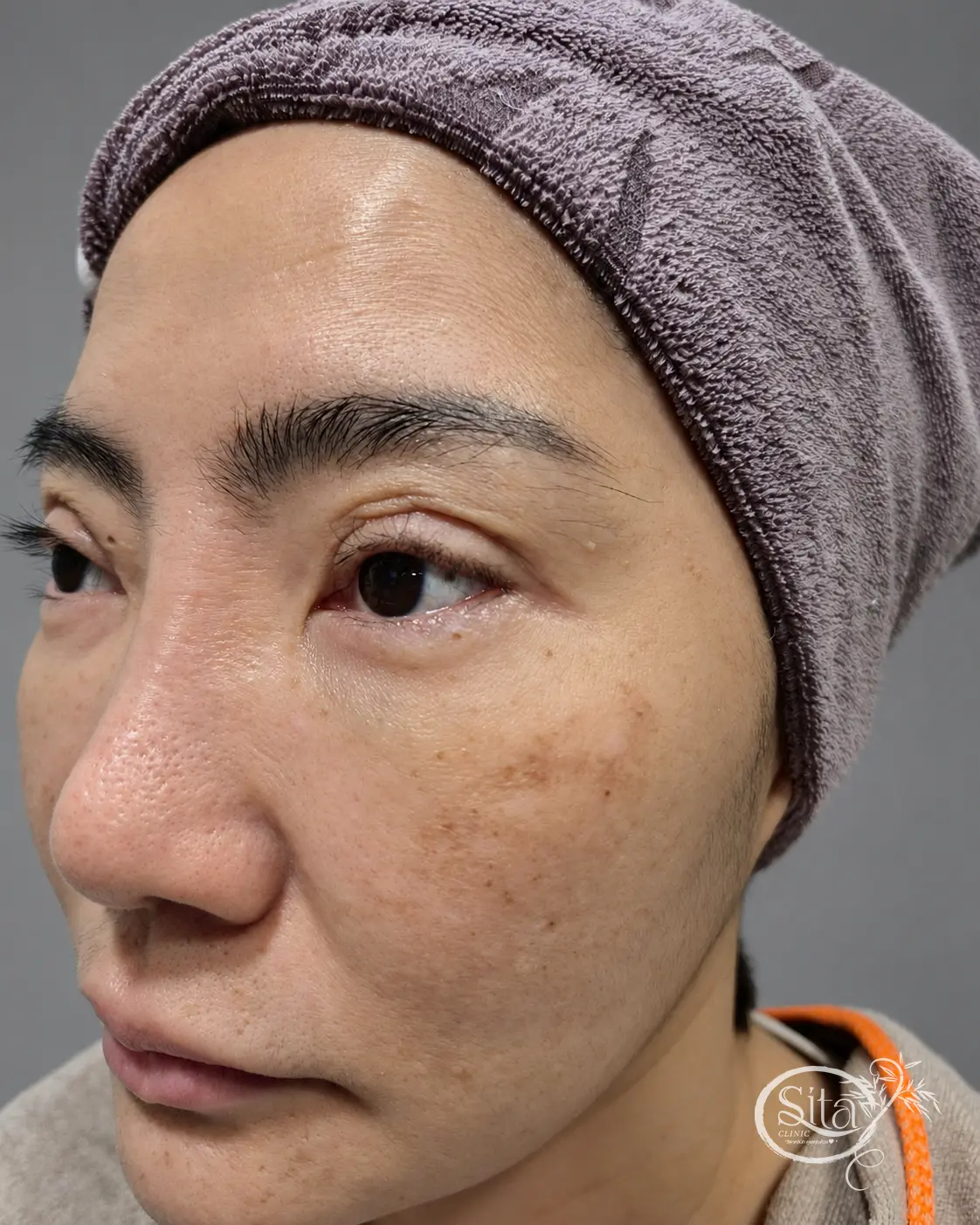
This patient was not starting from zero.
Before consulting SITA Clinic, she had received several forms of melasma treatment, but the outcome had not met her expectations.
This is like repairing a house in several places while the problem keeps returning. If we only see a crack and keep filling it, we may miss more important questions: where did the problem begin, which factors are connected and what needs attention first?
Skin care can be similar.
After several treatments, adding another treatment or switching to a different device may not always be the first answer.
What the team wanted to review first was
what had happened so far and where care priorities should begin again.
02
CONTEXT
Context to understand
The case information records hormonal factors as part of the context.
However, the term “hormonal melasma” does not mean that hormones explain everything about the melasma, or that everyone with a similar context should receive the same care.
For SITA, information about hormones is one part of the whole picture, rather than a label that immediately determines a standard treatment plan.
It is like putting together a jigsaw puzzle.
One important piece helps us understand the picture, but it still needs to be considered alongside the others: previous care, the skin’s response and what is happening at the time.
03
ASSESSMENT
Assessment
For a case involving multiple previous approaches to care, one important principle is to begin by asking something other than
“Which device will we use today?”
We begin by asking
“Given this person’s skin and circumstances, what needs attention first?”
SITA’s approach does not rely on a single device or procedure as the answer for everyone. It begins with an overall assessment, setting priorities and selecting care to suit the individual.
This Patient Journey includes only information confirmed for this case. We do not add medical details that are not available, such as pigment depth, types of previous treatment or examination findings.
The aim is to help readers understand the thinking behind care using the information available, without making the story appear more complete than the facts support.
04
CARE DIRECTION
Our approach to care
After assessing the case context, the team planned several aspects of care together.
This was not based on the idea that “doing more is always better”.
Each part had a different role, without relying on any one approach as the complete answer.
Think of caring for a plant that is beginning to show problems.
If we focus only on discoloured leaves without considering water, soil, light and the overall condition, we may not understand what is contributing to the problem.
The thinking behind this case is similar.
The team therefore planned care across several areas according to this patient’s context:
– Vitamin and nutritional support as appropriate to the individual
– Delivery of several medicines into the skin using medical devices, according to the team’s plan
– Care addressing the skin’s pigmentation system
– Support for overall skin health as a foundation for continued long-term care
The key point is not that SITA offers more treatments, devices or approaches than anyone else.
Rather,
we do not rely on any one treatment, laser, injection or device as the answer to every concern.
The first question is therefore not “Which method is best?”
It is
“What does your skin need now, and how should care be prioritised?”
05
FOLLOW-UP
Follow-up
Follow-up in this case is about more than whether melasma fades. It helps the team understand how the skin responds to the planned care, then consider what to continue, what to adjust and what does not need to be added immediately. Outcomes are still being monitored, so no conclusion will be drawn until confirmed information is available.
06
KEY TAKEAWAY
Key takeaway
For someone whose melasma has not improved as hoped after multiple treatments, the next question may not be
“Is there something stronger?”
or contact
“Is there a newer device?”
It may instead be
“Have we been addressing the right concern, in the right order?”
This is the message of this journey.
SITA is not saying that laser treatment is unsuitable in itself,
that treatments are unsuitable in themselves,
or that any one approach is inherently wrong.
Each approach may have a role in an appropriate context.
The difference lies in beginning with assessment of the person, then selecting and sequencing approaches to suit their context, rather than fitting every concern to one tool.
If you have tried several melasma treatments and are unsure how to proceed, you do not need to choose a treatment, laser or procedure beforehand.
Begin with an assessment of the whole picture, then consider which approach suits you.
The observations in this story reflect this patient’s context. They are not conclusions or outcomes that can be applied to everyone.
Continue reading
Other care stories
Each story has its own context and reasons behind care decisions. Explore other stories to understand how care journeys can differ.
PJ-004
Published
Melasma
Starting point
A patient in her late forties sought advice about melasma that had persisted for more than 10 years, alongside uneven skin tone and easily irritated skin. This case began with reviewing the skin condition and full care history, rather than immediately adding a procedure.
A reflection on the care process
This case does not suggest a single approach for everyone with melasma. It illustrates how, after multiple treatments, a reasonable starting point may be to pause, review the whole picture, support the skin’s readiness and reconsider priorities before choosing the next approach—like strengthening a foundation before addressing what is visible.
This Patient Journey describes an individual experience. Approaches and responses vary with skin condition, health, care history and context. It does not guarantee results, replace a diagnosis or advise readers to choose treatment themselves.
PJ-001
Published
Melasma
Starting point
Patient A sought advice about darker skin tone and areas of pigmentation that seemed to have spread after several approaches to skin care.
According to the history provided to the clinic, Patient A had undergone more than 10 laser sessions, received injections for melasma and used several skincare products.
The reason for reviewing care was not only the pigmentation, but also skin discomfort and concern that previous care might not have addressed the current problem.
Patient A described some areas as feeling similar to burned skin. This description is part of the patient’s account, not a diagnosis made from photographs alone.
A reflection on the care process
After multiple approaches to care, the next decision does not always need to begin with another procedure. In this story, reviewing the history, skin condition and previous responses was an important part of planning further care.